
Interesting diagram on the state of flow which is one of the most desirable states. We frequently try to move towards it. It provides a new perspective for looking at things

An endless revelation
Interesting diagram on the state of flow which is one of the most desirable states. We frequently try to move towards it. It provides a new perspective for looking at things

Taken from Yahoo answers: – original source: Journey of Souls by M.Newton.
For someone who has encountered hunger, cold, a shortage of amenities or a home, a deep seated fear and a need to protect oneself from the harsh realities of life gives an inordinate emphasis upon what others take for granted. For orphans, mothers are the most cherished and valuable assets in the world, because they grew up without one, for some it may be freedom if they were raised in an oppressive household, or love and someone to care for them should they have suffered neglect and abuse in childhood. Some covet fame and notoriety, or popularity to heighten self esteem, others fool around with anybody and everybody top enhance their own reputations, whilst good folk seek only one kindred soul to spend their life with. Life experiences dictate priorities. Having an important occasion and having nothing suitable to wear or not being able to afford to purchase much needed necessities always places greater weight on the accrual of capital. Depends upon personality type. Some spend and squander money, others remains frugal and money wise all their lives whether rich or poor. Spiritually rich as you seem to be, gives full enjoyment and extracts pleasure from ordinary daily happenings. If you have lots of money I suppose you can to a certain extent be godlike, in that you can have and do most things, perhaps that is what he means, money can give you more freedom and opportunity to experience life fully. But as I have little money I don’t fully understand his point of view.
||This part is more opinionated||
The happiest people you will ever meet have no money. If somebody tells you that life is all about money then you should feel pity for that person. Our current economic system is entering free-fall, and the only way that we’re going to prevent a catastrophe of biblical scale is by changing it. Pity the ones who love money, for they are lost: more-so than they can imagine! Join the people who just want to live, be happy, learn, enjoy life for the gift that it is and then you can feel true pity for those whose lives have been wasted chasing gold. The sooner you realize that you don’t need any of those things that you are told are essential, the sooner your soul will progress. We are here to learn, not to become rich.
Its funny, but there are different truths at different levels, all equally true from that corresponding level. In other words, truth can look different depending upon where you stand.
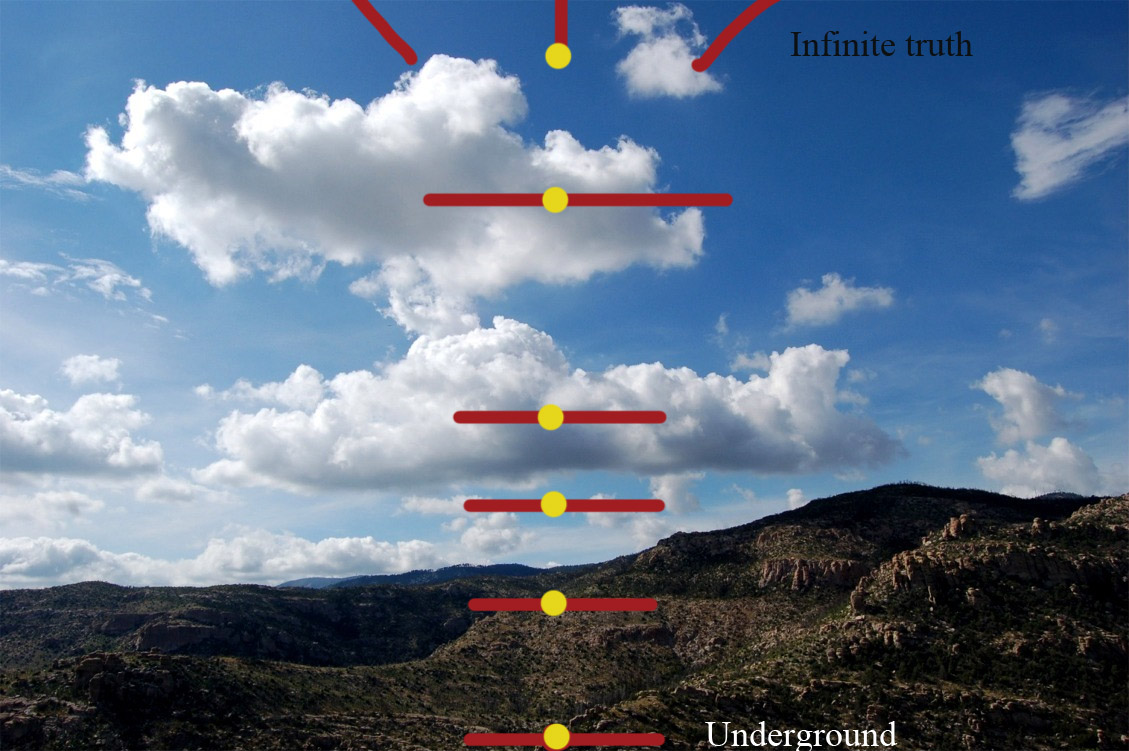
In the figure shown alongside, I’ve shown a kind of analogy.
1. For a person living in the cave, the truth is that he cannot see anything beyond the cave ceiling. This is the truth for him.
2. For a person living in the ground above, the first cloud he sees above him is his ceiling
3. At the next level he sees the cloud above him and so on
4. At the final level you just see infinity all around you which is above all the clouds.
Each jump radically alters your perspective. Its very hard to even conceive what a level above might feel like and what kind of insights may lie there. Its like trying to imagine a 4th dimension.
In relationships,
1. At the first level you think that this person is actually responsible for how your feeling and that object is directly controlling/manipulating you, creating a heaven or hell for you.
2. At the next level, you realize that it is actually the concept of this person that is causing you suffering/pleasure. The concept is more like a projection of what we want them to be, a dream. Since they can never be what you exactly want there is always some amount of suffering. Once you realize that it is the concept that is controlling your emotions and not the person himself, then you see that the next level of reality happens within you. If you can rewire that, the external object will not affect you anymore. So now you see the person and the concept of the person in your mind as 2 entities and you know that the concept is the real thing to be worked with because many other external objects can trigger the same reaction in you. You also realize that it is not just this one person who can bring about these feelings. Any object that satisfies the concept can fulfill you.
3. At the third level, you realize that feelings become emotions only after judging them as pleasant/unpleasant etc. So you separate feelings and emotion and objectively observe all feelings. At this level you can also observe that it is your attachment to certain thoughts that are causing suffering. The real emotions by themselves happening in the moment are like ripples in water. We just multiply their effect using memory.

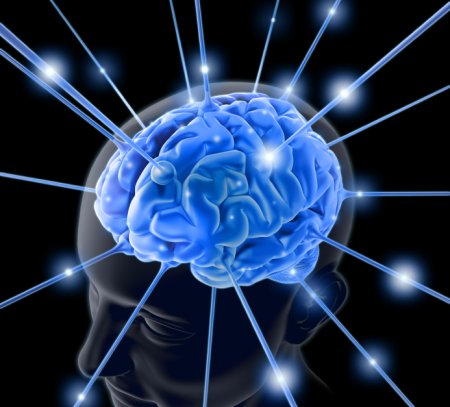
Are they the opposite of each other?one the subset of the other? is everything just one thing and we are just conceptualizing it into 2 things?
Do we meditate on ourselves till the point we get so comfortable with ourselves that self consciousness is transformed into expanding consciousness?
Can our single pointed attention solve any problem? Fears, distractions, obsessions etc?

Like take the example of music, you truly enjoy it only after a long silence or if you do a totally unrelated task which required your concentration. Thirst is truly felt only when you are deprived of water for long enough with strenuous activity alongside. You start noticing the faintest of lights in a dark room if you stay awake there for more than 10-20mins.
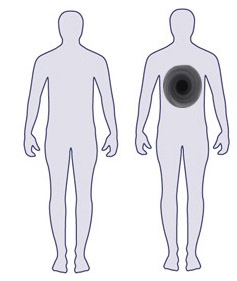
Before desire originates we are complete and a whole – left figure. Once we see something attractive that we want to possess a sort of sinking hole is created in our chest – ‘right figure’ and makes us feel incomplete and there is a desire to fill this lack up by acquiring the person/item/idea etc.
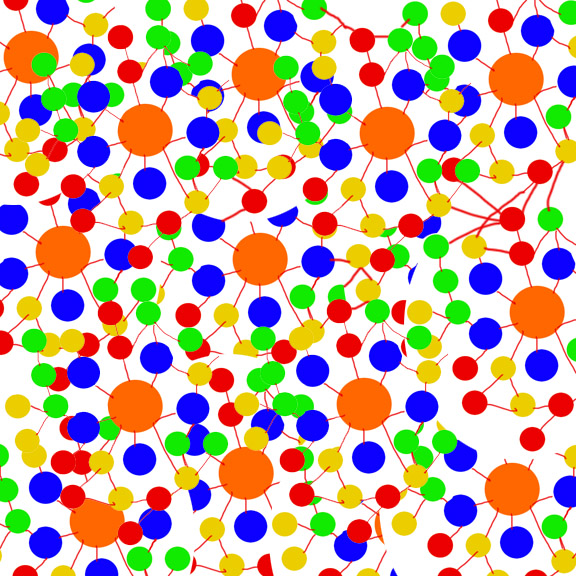
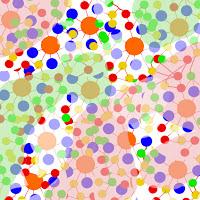
The first picture shows the real objective picture/reality – all the circles and lines represent associations in the brain. The 2nd one shows the same picture but after I have been influenced by other people’s opinions – red and green shows the bias, desirable/undesirable. Some people are ridiculously opinionated. For every single concept even they have a good/bad judgment about it. Mostly their views are completely untrue and extremely biased. The problem is that we tend to first believe in something then logically analyze it if its true or not. Also, when you don’t know about a particular subject, its an even bigger problem and in group discussions these guys just keep littering opinions after opinions with a surprising amount of confidence. Its a pain to keep your guard all the time to ensure you don’t get affected. Usually I temporarily get this cataract like vision and then it takes me a few hours alone and some thinking to get back my original views. Every single thing is packaged into a box with a label of either good/bad/desirable/undesirable etc and the sad part is that, these people have no clue that there knowledge is just a distorted version through the screen of their thinking. Surprisingly such people elicit good social support and many people actually support their distorted views. This is what is real education, that WE DON’T KNOW and no one can have absolute knowledge and we need to have a certain degree of humility.

We could break down the process of what we call thinking into 3 elemantary processes:
1. Analysis
– how, when, what, where, which , who etc.
2. Comparison
– The most common points of Comparison, for the purpose of discovering “likeness” and “unlikeness,” are as follows: Name; Place; Time; Shape; Cause; Effect; Use; Actions; General Idea or Character; History; Origin; and Destination
– Used to build the web network of associations
3. Classification
– Concept formation
– The value of our ‘Thought’ depends largely upon the correctness of our Concepts
4. Reasoning
– Reasoning presents itself as a short cut to knowledge—a formula by means of which we may acquire knowledge from general principles
(1) Reasoning by Analogy – “If two things resemble each other in many points, they will probably resemble each other in more points”
(2) Reasoning by Induction – “What is true of the many is true of the whole”, based on the belief of uniformity of Nature
(3) Reasoning by Deduction- syllogism, “What is true of the whole, is true of its parts”
Here is an extract from the article: http://www.psitek.net/pages/PsiTek-the-master-mind13.html
It talks about the comparison phase.
Experience, however, has given the race the almost intuitive and instinctive realization of “the pairs of opposites,” or “contradictories.” So true is this that the trained mind instinctively leaps to the thought of an “opposite” at the same time that it is considering any given quality. It thinks of this “opposite” not because of its “likeness” to the thing under consideration, but because of its “un-likeness” or difference. So true is this that psychologists hold that we can obtain a clearer and more distinct idea or mental image of anything if we will at the same time think of its “opposite”—either its opposite quality, or a thing whose qualities are markedly opposite to that of the thing under consideration. In associating a thing with others in our memory, or thought, we do so by (1) association with “like” things, and (2) by association with “unlike” ones. The greater the “likeness” the greater is the strength and value of the first form of association; and the greater the “unlikeness” the greater is the strength and value of the second form.
So if you have realized the ‘nothingness’ state of mind, anything when compared to that is full and complete knowledge giving ultimate satisfaction of ‘real knowing’.
Some more interesting points from the article:
– Words do not convey thoughts; they are not vehicles of thoughts in any true sense of that term. A word is merely a common symbol which each person associates with his own idea or image.
– In syllogism, question the major premise and the whole chain is broken
– It is not a sound argument, nor logical reasoning, to appeal from the principle under consideration to the personal practices of the person advocating the practice. For instance, a man arguing the advantages of Temperance may be very intemperate himself; but to point to his intemperate habits is no proof or argument that the principle of Temperance is incorrect. A proposition is either true or untrue, regardless of the personal character of the persons advocating or presenting it.
-“Many persons reason from their feelings rather than from their intellect. They seek and advance not true reasons, but excuses. They seek to prove a thing to be true, simply because they want it to be true. The tendency is to see only those facts which agree with our likes, or are in line with our prejudices; and to ignore the other set of facts. Such persons unconsciously assume the mental attitude which may be expressed as follows: ‘If the facts do not agree with my pet theories or prejudices, so much the worse for the facts.'”
-“Nine times out of ten, to argue with any man on a subject that engages his emotions is to waste breath. His mind is not open to logical persuasion. His emotions first determines his opinion and then prompt his logical faculties to devise plausible excuses for it. There is a thing that psychologists call a ‘complex.’ It consists of an idea charged with emotion, and it operates as a sort of colored screen in front of the mind. A man whose emotions are deeply engaged on one side of a question may think that he is reasoning about it. But, in fact, he may be incapable of reasoning about it, because whatever impressions his mind receives in that connection come through his complex and take no color. His logical faculties operate only by way of inventing plausible defenses for the judgment his emotions have already formed. It is impossible to change his position in any respect by reasoning, because reason cannot touch his mind until his emotions have dealt with it and made it conform to their color. Whenever you talk to a person with a strong bias on any particular subject, which bias does not coincide with your own bias, talk to him about something else.”
– Useful line of thought: “What practical difference will it make if I hold one opinion or another? How will my belief influence my action?’ (using the word ‘action’ in its broadest sense). This may often lead our line of inquiry into more fruitful channels, keep us from making fine but needless distinctions, help us to word our question more relevantly, and lead us to make distinctions where we really need them.”

 Journey to the Abstract