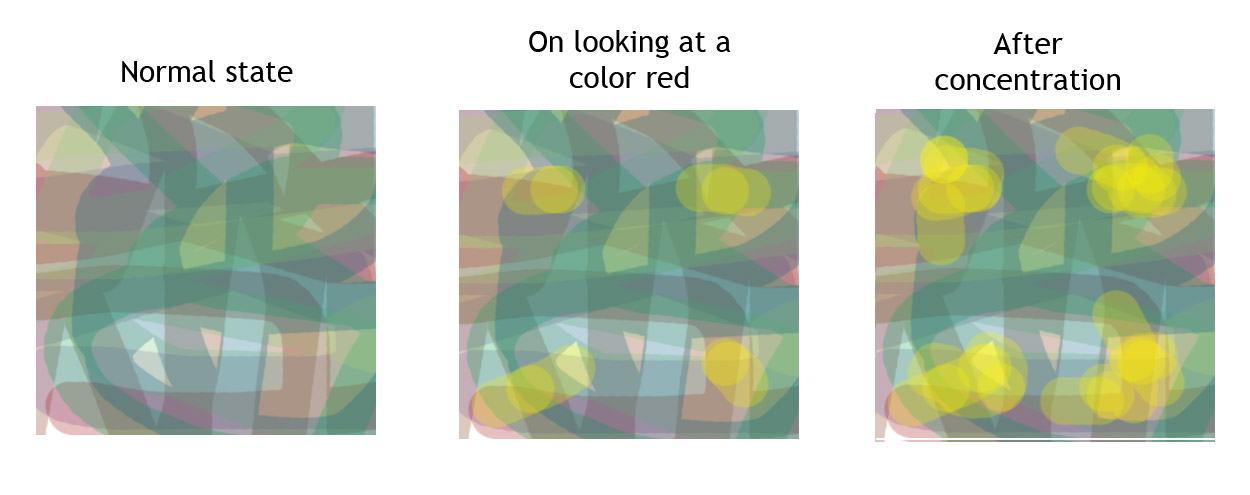
Suppose you see the color red. What exact happens in your mental state. Maybe, to understand this, we may need to look into many fields such as Neuro-biology, science of perception etc. Now supposing you concentrate on this feeling of looking at red strongly, you can augment and enhance the feeling (neurological activity increase shown in the diagram). Maybe consuming a hallucinogen drug would do this w/o any effort from your side. So understanding the mental state change and holding on to it to understand it may be a part of meditation.
Random musings 2
For E.g.:
Desire: Want to be a helpful person and appear that way
Higher Goal: The goal would be that I would help any person who comes by to the best of my ability, taking into account the situation and myself, expecting no reward. The only reward being the intrinsic one i.e. the mental state in the moments of doing the help.
Desire: Want to move up the corporate ladder and gain respect.
Higher Goal: See the company’s higher mission and see its principles find any resonance in you. Do the work to the best of your ability w/o expecting immediate reward. The reward should be intrinsic i.e. the fact that you are doing the work with the most attention possible using the best of your ability is the reward. Whatever may be the work, there is infinite scope for improvement at greater levels of subtlety.
Desire: I want people to read this blog and appreciate me and find a new found respect for me.
Higher Goal: This blog is for inspire people to explore new ways of thinking and find new freedom and directions.
Even Higher Goal: I am writing this blog to share the evolution of my thinking w/o any judgment of right/wrong/good/bad. I want to share my life’s journey of this form of contemplative thinking. It is for this intrinsic desire to share my thoughts. Rest of the benefits are just added luxuries.
In colloquial terms, a man of principles is operating at a higher level in terms of his goals. If you notice, as one goes higher up in the goal ladder, the goal becomes less time oriented and more related to a state of mind. The goals also moves more towards permanency. It starts of with the external world and then the higher you go in terms of goals you reach the internal. Usually, as you move towards intrinsic, the external becomes more of a luxury. Its like you would get 70% satisfied just by the intrinsic reward. The remaining 30% can come from others’ appreciation and respect and its more like a luxury.
Look at all the great people like Albert Einstein, Leonardo Da Vince. Their level of thinking and goals were fundamentally different from what we can imagine. That is why they say, if your goal is only to win a Nobel prize, its unlikely you will because a goal like that simply does not have have that much energy.
Extending that logic, as you get move towards intrinsic, your energy to accomplish the goal becomes tremendously higher. I think the highest goal might be complete self knowledge, a permanent state from “moment to moment” and the goal may just simply be “self actualization at every moment” (maybe words cannot really convey this, just an attempt). This also explains the other proverb “Higher the goal, higher the energy”.
As you take up higher goals, the number of people available to identify with would decrease. For most people, their goals are mostly from getting from point A to B and they don’t really care about “Why”, they just know it at an extremely superficial level.
In other words, you shift your reward feedback from external to internal. Ultimately external reward is an illusion. All reward comes from within. The external system is just a catalyst. The problem is that, we don’t know how our internal system works. Its more like a black box. So we depend on external systems because they are tangible and more directly understandable. All drugs work on already existing chemicals/mechanisms in your brain and create those unique states.
Why do most children enjoy playing games? Even plenty of grown ups enjoy this. However I’ve often noticed that people in their mid-career quote “Ohh gone are those days when I used to play games. Now I’ve far too mature and developed to enjoy those things. I am embroiled in real life issues now. No more games”. This answer amuses me. Life itself is a gigantic 4-D simulator. The game of life and PC/console games mainly differ in their level of abstraction (to put it mildly). Even when we move from 2-D to 3-D space, the amount of complexity added is unbelievable. Just think a 2D plane consists of infinite lines in all directions. A 3-D space consists of infinite 2-D planes in all 3-axes and in infinite angles etc. The level of complexity added at each dimension is just mind boggling. That’s why probably the game of life is so compelling, its unusually difficult to identify that it is a game. I think the reason is the attachments we have to things that prevent us from seeing the real picture. That’s why detachment always helps in uncovering more and more objectivity in things and maybe reach a state where you are able to spot this illusion. Like a fish which slowly gets itself out of the water into air and when it gets back it realizes that “IT IS IN WATER”. The other fish would simply think nothing else exists besides water because everywhere they go, that’s all they find. I think that is probably the moment of enlightenment when you perceive that all the things that you think are so different are probably all from the same source. The formless, shapeless, nameless.
It is like an ontology where relationships are figured out between seemingly unconnected entities. The whole evolution of the semantic web basically tries to link everything together in some way as a web and add meaning to all the information floating in the internet.
I think identification with form is the illusion. Our subconscious minds think in images and our conscious mind thinks verbally. Both of these need to be transcended to break the illusion. At a more micro level, all we seek are mental states. We are attached to a lot of them and we spend our lives constantly trying to recreate them.
This ‘source’ may be impossible to explain in words since words are just an abstraction. The entire human language is just a system of abstractions of the real thing and it is still evolving. There is great scope. The next leap could be telepathic communication and even in that, to what depth it is possible etc. leaves huge potential.
Thus, once the source is discovered, everything emanates from that and therefore nothing is unconnected and you can truly understanding anything. You would know the a level of subtlety far far beyond norm taking you into another world. “Nothing in the world is absolute”, because the very instruments (our senses and mind) we use to observe can only uncover a tiny part of reality.
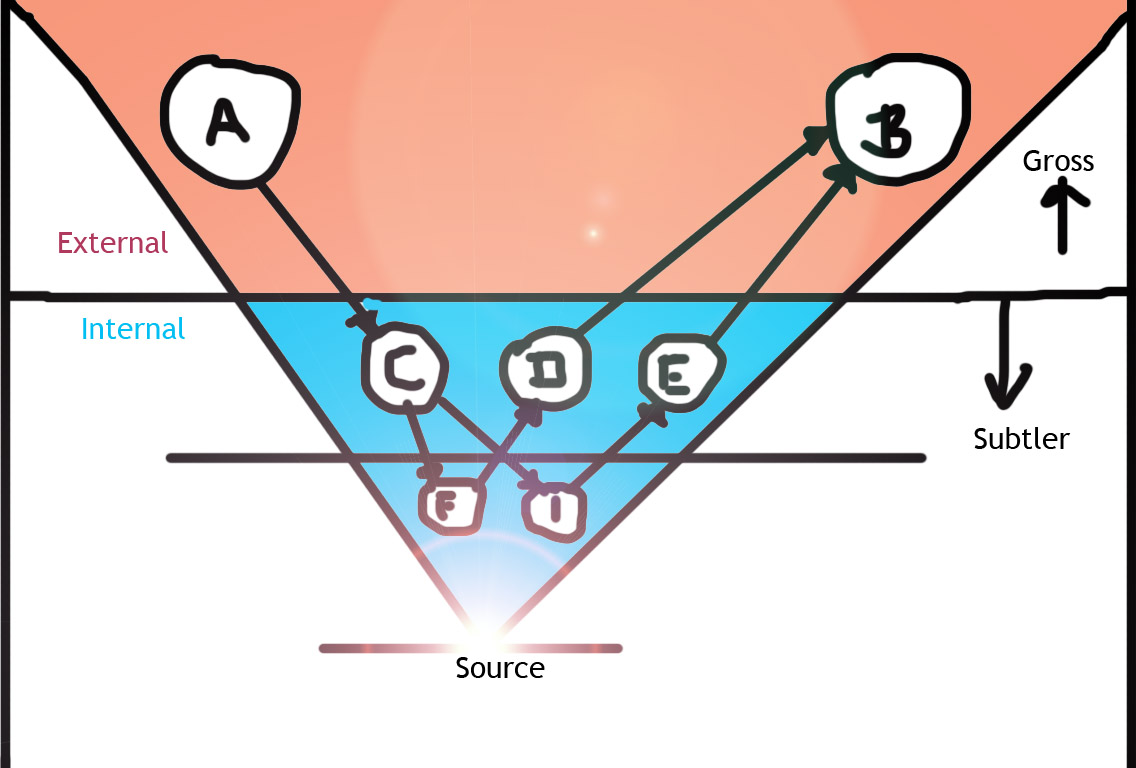
Look at these ontology diagrams for an analogy of what I me:
Can you ever really understand the relationship between A and B in the external reality(red portion) without understanding the internal part of it(blue portion)?. If you look only at the external side you might think they are very distinct entities totally unconnected. This could create strong dualities. For eg: (Good, evil), (pleasant, unpleasant) etc.
Would you call that true knowledge of A and B?
The total connecting paths are:
A to B = ACFDB, ACIEB
From the source, all these connections become visible. They may look completely unconnected in the external reality. That is why it is called true knowledge. It is the highest goal.
Why is gold so valuable?
Culture has infused the belief that gold is really valuable. It is rare and difficult to obtain therefore high in value. Surprisingly, almost all over the world its considered valuable. It is true that as a metal it has some great properties but are we really seeing value those those properties intuitively?. Can we perceive its inherent value outside of cultural conditioning?.
I was wondering, some people are as valuable as gold or even diamonds. The metaphor seems to perfectly fit in metaphysically. Some people so perfectly fit our archetype of a perfect person, subjectively they are really as rare as gold or even a diamond. What is the chance you would meet someone at that level again in your lifetime?
Childhood fascinations
2. See large beach waves – 10ft or more
3. Experience a cyclone – 150kmph+
4. See giant statues in Egypt and imagine them to be real giants. To really FEEL the size difference.
5. Real life version of anything in the tomb raider PC game series
6. Anything related to experiencing speed
Â
7. Shrinking to a size of an ant and experiencing the word – ps: need a parachute and a jetpack
Nature – 20%….Nuture – 80%
2. Studies have proved that the brain retains plasticity until old age. This means the hardware itself is living and dynamic. The ‘useless’ concept is just relative.
3. Many of us have debilitating beliefs about ourselves in certain departments that can totally prevent success.
4. 99% of the population do not really question their core beliefs(its a profound topic) and find out who they really are. How can you make conclusions about yourself when you don’t even know who you are.
5. A child in a more stimulating environment can develop much faster than a child who is put in an under stimulating environment, assuming the same hardware. Similarly, a loved child in a secure environment usually ends up with better hardware and coping mechanisms. ADD too is often an outcome of inadequate attention in childhood.
There are just too many factors like the above. The more I think, the more I feel that judgments really have little value.
Stuck in certain patterns of conversations
1. Statistics, trivia, information or gossip related to jobs and companies.
2. People – husbands, seniors, double seniors
3. Regions in India and language discussions, Indian culture
4. Professor, their achievements, courses – related to their market value
5. Movie and actor trivia
6. Indian politics, little bit international
7. Thoughts about longing to buy a car
8. Aggressive teasing with an element of ‘looking down upon’
Langauge is just a form of reductionism?
Also, things thoughts can be conveyed and understood by another person only if he/she has had a similar experience or something to extrapolate on.
Think about the following examples:
1. Can you explain to a 10yr old, what can orgasm might feel like?
2. Can you explain what a lucid dream might feel like to someone who has never heard of it?
3. Can you explain what colors look like to a blind person?
4. Can you explain what an alcohol high feels like to a person who has never touched it?
5. Can you explain what is music to a person who has never heard any?
6. Can you explain humor, or what makes us laugh?
Magic goggles and mirrors
When I speak to some people to share my problem and get perspectives on it, sometimes their stark lack of awareness is revealed OR in case our views absolutely oppose(which is very common because I’m kind of a free thinker) while opening up to them the whole environment becomes an egoistic showdown. Each offends/defends with their point of view or tries to withdraw. Esp when it is with a person with whom I’ve spent a lot of time, they think they know me too well and this exacerbates the miserable feeling and the other person’s life starts looking rosier because of their lack of the problem which I’m so involved in. If i visualize it it kind of looks like the goggles which I use to see the world get distorted and I see my life as a stormy cloud and their life as even rosier, like say a rainbow shown in the left part of the diagram.
Sometimes, when I’m deeply admired by someone and they really understand me and share their vulnerabilities with me, I feel the exact opposite(shown in the right side of the figure) and this good feeling overflows as love/compassion towards the other person.
I find it hard to believe how this goggle filter distorts so much between these 2 experiences. What is the objective truth then?What can I infer?Is the goggle what we call as ego/image of self which transform the way you perceive reality? On examination I feel I cannot trust this perception anymore.
Each person I meet is like a magic mirror since I look totally different in these mirrors each time depending on that person’s state of mind and my own state. For e.g.: If I drink alcohol with a friend whose similar to me, both of us start reflecting off the pleasant state from our mirrors making us look much better in each others’ mirrors.
Random musings
Are we really creating our reality/self at every moment? That thought kind of puts a LOT more responsibility. Do I really need to make choices at every single moment? Making choices once a way scares me enough! I can generally handle one moment at a time very well or even short plans for like half a day. What really hits me are long term goals. I absolutely have no clue. If there is so much of uncertainty even in such a short amount of time, how practical is it to make a long term goal. And what about my dynamic self. I’m so dynamic in my opinions, thoughts and beliefs that what matters now may not even matter after a short while. How can I be dynamic and have a long term goal? Doesn’t that mean I would have to lock my priorities for a very long period of time? How is that freedom? Most enlightened people simply live in the moment because they know this truth. This enables them to fully experience the present like a child. Maybe that is why they live away from cities. I do have certain long term goals, but aligning some of them with society’s expectations is a serious pain. Its like society has a road map set, which I have been following since childhood. The pressure from society to conform is absolutely overwhelming. Why are there so few free thinkers? (its a Q that still beats me)
I generally like to operate at the fringe of my reasoning, opinions and beliefs and continually expand that sphere in all directions. The larger the sphere the more expansive and free I feel. Generally, when I’m talking to a rigid guy about an unknown topic, he gives me a distorted version and tells me that is the truth. That is like walking through narrow paths with walls on either side and reaching a destination(the destination may be a highly distorted opinion). The problem is that, to validate whether the walls are real or not, you need to explore by yourself (see multiple perspectives on the issue). Most of the time, the walls are an illusion. So for me the destination is just the fringe of what I think is possible with my current level of knowledge, experience or imagination. If I reach the fringe of reasoning and go beyond it, then I place a new checkpoint flag and continue to see if I can expand. My thinking force is centrifugal in a 3D sense. I want to expand in all directions. I do not have any fixed destination. What I seek is not an end goal, but a particular state of mind which is open to everything, filled with curiosity and wonder, greatly enriching people’s knowledge and lives, with an extremely high level of wisdom.
Concentrating on music in layers
Since I had a synthesizer/keyboard in childhood, I kind of learnt to hear individual tracks separately in an accompaniment or song.
Percussion 1,2 – Drums…Bass…rhythm 1,2 – guitars, Pad chord – strings, melody 1,2 – special effects or inserts.
8 tracks in the accompaniment
1 lead track, 1 track supplementing the lead etc.
In a typical song, I can easily break up 7-8 tracks and hear them individually. I think this is a great concentration exercise and it really helps you get deeper into the music.