— Energy is subjective: What feels like high or low energy is relative to one’s own lifetime experiences.
— Imagination as amplifier: It can intensify both joy and suffering by multiplying aspects of memory and emotion.
— Social interaction as catalyst: Without engagement with other beings, human or otherwise, a vital dimension of energetic activation remains dormant.
— Connection through commonality: Resonance arises most easily when there’s a shared “frequency”, a common denominator of experience, emotion, or intention.
— Alienation through uniqueness: When one’s energetic makeup is radically different from others, this can lead to a feeling of deep existential disconnection.
— Unconscious systems dominate: Most of what drives attraction, resonance, and energetic interplay operates beneath conscious awareness, within the “90%” of the unconscious system.
— Resonance ≠ alignment of intention: Two people may deeply resonate due to shared trauma or experience, yet be repelled if their responses to that experience diverge e.g., one seeks closure through compartmentalization and forward motion, while the other seeks total understanding and transcendence through full confrontation and deconstruction. Resonance alone does not ensure relational harmony.
Illusion of infinite need that comes from intensity of deprivation
When we are extremely thirsty,
If we just go by the perceived feeling,
We’d feel we want to buy a tanker of water,
But really we might at most need a jar of water to get fully satisfied.
It is sometimes surprising how just a little of something can be enough,
Even when it comes to abstract needs like connection, belonging, recognition etc.
The reason behind our experience of free will
We think we have free will because we are blind in the time dimension.
We only rely on the computation using ‘present moment perception’ and ‘stored memory of the past’ to take decisions that would shape our future.
But if we could see into the time dimension itself, then no such thing as a ‘free-will’ experience would exist.
This is wonderfully captured in the movie ‘Arrival’.
Hatred and Love are about wanting change or no-change
Hatred is about trying to change something (push).
Love is about trying to preserve something (pull).
Hate and Love are for the ‘External world’ and the ‘Internalized world’.
– The ‘External world’ providing the good or bad experience
– The ‘Internalized world’ holding the good or bad experience
Conditioning is basically the ‘Internalized world’ derived from the ‘External world’.
It ties into craving (love) and aversion (hate).
Wanting to include –vs– Wanting to exclude.
Wanting to keep –vs– Wanting to remove.
Loved things torture you when they are gone.
Hated things torture you when they are there.
Hatred and Love are both responses to impermanence.
They are efforts to negotiate with the flow of change.
The only thing I am craving
In a way the only thing I am looking for is:
Intense/Immense/Profound meaning/voltage(PD)/current/movement/flow.
Be it additive, subtractive/dissolving, transforming.
The only reason you feel attracted to an other
The only reason you feel attracted to an other,
Is if they make you feel better than you would feel by yourself alone.
Concentration is like sugar
Concentration is like sugar.
Mixed with anything, it adds pleasantness.
Some insights on change and free will
Generally, when we think of change,
We think of it in objective/external terms,
Like day-night cycles, season cycles, the rusting of iron, and so on.
So in this context,
We can study these changes, and make prediction models.
Here the subject stays as a relatively stable witness to the changing objects outside.
Changes of this kind are actually fairly superficial in our experience.
The subject is relatively unchanging while the object is changing a lot more.
Like when some people go on a vacation,
They are mostly the same people in different outer situations.
They mostly feel and act the same.
But there is another kind of change,
That is not objective, but subjective,
That is not outside, but inside.
Here, since the very subject changes,
This kind of change is unpredictable and profound,
It feels more like magic.
This kind of change is like when a person takes a medium dose of LSD.
There is a dramatic internal change that changes everything in their experience.
Childhood also is like that,
Where we go through dramatic shifts in our very view of reality itself with every passing year.
I am using the words objective and subjective in a more loose and colloquial sense here.
If I look at it deeper, all objectivity too would collapse into the subjective,
Where only the “Subjective” would exist.
Similarly I could also argue, that every subjective experience could theoretically be determined by objective factors that we still do not yet have the necessary subtle-enough instruments to define, study, and alter.
Objectivity = 3rd person perspective (3rd pp)
Subjectivity = 1st person perspective (1st pp)
All 3rd pp could be said to be subsumed into 1st pp.
I tend to look at all change as change in your state of consciousness (SoC).
Birth and Death are times of great change in consciousness.
Could equate it to sunrise and sunset?
While our Lifetime is more linear and less dramatic?
Could equate lifetime to day-time and after-death to night-time?
After death could be some unfathomable mystery though.
I think what is generally called free-will is the situation where:
We have a relatively unchanging subject in a changing outer world.
So then the subject is able to exert his/her steady will on the changing outer world and build things.
There is much less free will when we are undergoing any transformations of subject.
Here the subject changes relatively much faster than the outer world rhythms.
Transformation times are like kayaking in rapids.
The free will then has to be mostly used in service of the transforming force,
In navigating the rapid change,
So as to keep maintaining order and balance through the changes.
Free will feels like the mirage illusion
Free will feels like the mirage illusion in my experience.
If I don’t pay close attention to it or without close examination,
It feels like it is always there.
But once I really concentrate on it and pay very close attention,
I find that it vanishes.
Then once again, once my mind moves over to other things,
The free will component seems to reappear.
It reminds me of the illusion of solidity we experience.
When looking deeper and deeper into the atom,
We find 99.99% empty space.
But yet on returning to daily life,
We once again experience solidity everywhere.
The blind men and the elephant analogy describes our experience with time
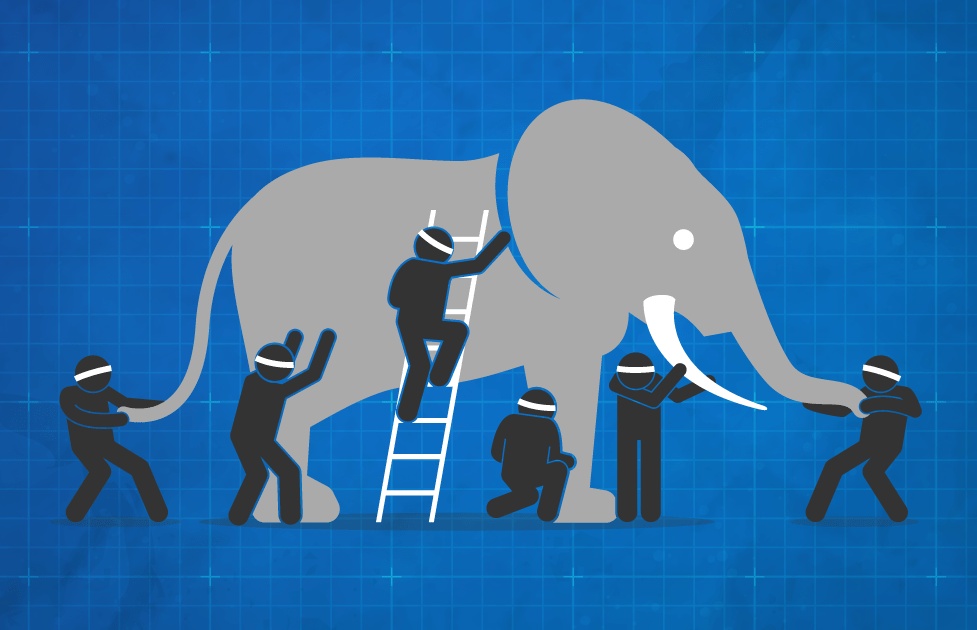
Time = Kala/Darkness/Blankness.
When it comes to time, we live like blind men.
Unable to see beyond the present moment,
Living moment to moment.
Someone whose time is good says life is good,
Someone whose time is bad says life is bad.
Who is right?
Someone who is dying says life is destruction.
Someone who is at a thriving stage says life is constructive.
Who has the correct view of what life is?
This reminds me of the analogy of the blind men and the elephant.
Depending on what they feel,
They create a model of what life is based on that.
We live moment to moment, unable to sense time itself.
With our eyes open we can perceive reasonably large amounts of space.
But when it comes to time, we have no such sense.
The longer we live, the more we use our memory to model what life is like.
But we only base our idea by retrospect.
If time changes in a way that is different from our immediate past,
We cannot know.
 Journey to the Abstract