List of Inspirational Speakers

  1. Eckhart Tolle
  2. Shinzen Young
  3. Sadhguru
  4. Adyashanti
  5. Terrence Mckenna
  6. Bashar
  7. Robert Alias
  8. Jeff Foster
  9. PillaiCenter: Dattatreya siva baba
  10. Swami Vivekananda
  11. Richard Feyman
  12. Alan Watts
  13. UG Krishamurti
  14. Jiddu Krishnamurti
  15. Mooji
  16. Abraham Hicks
  17. Deepak Chopra
  18. Conference Report Youtube Channel (certain parts)
  19. Osho
  20. Ozen Rajneesh
  21. Peter Marchand
  22. Peter Russell
  23. Wayne Dyer- Taoism
  24. Michael Webb – A culture towards awakening blog
  25. Sage Bodhisattva (YouTube)
  26. Ram Daas
  27. Yuttadhammo
  28. Adi Da
  29. Benitho Massaro
  30. Scott Kiloby
  31. Charlie Hayes
  32. Vijai S Shankar
  33. Tony Parsons
  34.   (YouTube)
  35. Krishnananda (successor to Sivananda)
  36. Gurdjieff
  37. Ouspensky
  38. Nityananda
  39. ScientificMysticism (YouTube)
  40. Rupert Spira
  41. Francis Lucille
  42. Robert Wolfe
  43. Jiddu Krishnamurti – Non duality cartoons
  44. Nisargadatta Maharaj
  45. Jed Mckenna
  46. Ramana Maharishi
  47. Timothy Leary
  48. Bruce Lee
  49. Carl Jung
  50. Lisa Cairns
  51. Shunyamurti
  52. Richard Lang
  53. Douglas Harding
  54. Andrew Cohen
  55. Abraham Hicks
  56. Sen (Calm down mind)
  57. Gabor Mate
  58. Paul Brunton
  59. St. John of the Cross
  60. Atulanand Ji
  61. Ramesh S. Balsekar
  62. Peter Russel
  63. Maithreyaa Swame
  64. Barry Long
  65. David Hawkins
  66. Ishwar Puri
  67. Linda Clair
  68. Kyle Cease
  69. Gary Weber
  70. Manly P. Hall
  71. Youtube: Channel higher self
  72. Almine
  73. Jayson Wiggins
  74. Peter Holleran (Mountainrunnerdoc blog)
  75. Shunya Yoga – Amir Mourad
  76. Joe Rogan
  77. Benjamin Smythe
  78. Robert Anton Wilson – 8 circuit model
  79. Ocyphius
  80. Jason Shulman
  81. Baba Ramdev
  82. Scott Mandelker
  83. Thich Nhat Hanh
  84. Mark Passio
  85. Ra – Law of One
  86. Trevor Ilesley
  87. Jordan Peterson
  88. Matt-Kahn
  89. Sam Harris
  90. Dr. Michael Laitman
  91. Brian Alger
  92. Alan Mcfarlane
  93. Sri Summairu
  94. Dr Hew Len
  95. Burt Harding
  96. Mukti (Adyashanti’s wife)
  97. Elliott Hulse
  98. Eli Jaxon-Bear
  99. Poonja Papaji
  100. Anadi
  101. Craig Holiday
  102. Michael Beckwith
  103. Sam Geppi (astrologer)
  104. Swami Kriyananda
  105. Brijesh Gautam (hindi discourse)
  106. Tom Campbell (simulation theory)
  107. Teal Swan
  108. Aaron Abke
  109. Yogaprasad Institute (YouTube channel)
  110. Swami Sarvapriyananda
  111. Yogiraj SatGurunath Siddhanath
  112. Acharya Prashant
  113. Swami Satchitananda
  114. Om Swami
  115. Kaulantak Nath
  116. Mohanji
  117. Russell Brand
  118. Sri M
  119. Wim Hof
  120. Sri Sri Ravishankar
  121. Jason Gregory
  122. Swami Prajnananda
  123. Guruji Naushir

Books recommended:

1. In Search of the Miraculous – PD Ouspensky
2. States of Consciousness – Charles Tart
3. Altered States of Consciousness – Charles Tart
4. Breaking open the head (A Psychedelic Journey)- Daniel Pinchbeck
5. I am that – Nisargadatta Maharaj
6. Open Secret – Wei Wu Wei
7. The Attention revolution – Alan Wallace
8. Spiritual Enlightenment the damnedest thing – Jed Mckenna
9. Alkuajatus – The original thought
10. Alkuajatus – Report from a free world
11. A course in consciousness
12. The Ayahuasca Experience – Antipodes of the mind
13. Non-violent communication – Marshall
14. Freedom from the known – Jiddu Krishnamurti
15. Disappearance of the universe – Gary Renard
16. Confusion no more – Ramesh Balsekar
17. Yoga Sutras – Patanjali (http://www.swamij.com/yoga-sutras.htm)
18. Care of the soul – Thomas Moore
19. Ego and the Dynamic Ground – Michael Washburn
20. Collision with the Infinite – Suzanne Segal
21. The point of existence – Transformations of Narcissism – A. H. Almaas
22. The pearl beyond price – Integration of Personality into Being – A.H. Almaas
23. Mystic Musings – Sadhguru
24. Fading towards enlightenment – Wayne Wirs
25. Living with Reality – Who we are…
26. Dispelling Wetiko: Breaking the Curse of Evil
27. Bruce Lee – Artist of life
28. Kabbalistic Healing – A path to an awakened soul
29. The Kybalion – By three initiates
30. Pathwork lectures: http://pathwork.org/the-lectures/
31. Power vs. Force – David Hawkins
32. Death – An Inside Story
33. Meher Baba – God speaks
34. Karma: A Yogi’s Guide to Crafting Your Destiny
35. Vedanta Treatise: The Eternities
36. Karma: By Acharya Prashant

Thoughts – 7 Mar

If meaning is a choice we make…what is the best way to create this equation….would anyone voluntarily choose and follow society’s constructs after discovering this knowledge?….Deriving one’s sense of worth and meaning from society seems to be a huge postponement and a very circuitous way where you need to attain X at each stage

The entire society is man’s collective attempt to create order and is always constantly challenged by chaos…

What is the thing we take for most granted? Probably the air we breathe?What if we were grateful for every breath? Wouldn’t it give us the highest sensitivity for the sublime feeling of satisfaction?

The whole sense of meaning/experience is completely unique to each individual and in a way all are equivalent.

Each dominant emotion in humans is countered by its dual in others. The question is will black or white win? But nothing can win in a sense because they depend on each other. One implies the other so they are one.

Pure concepts are imaginary and too simplistic to actually exist.

If you want to maximize pleasure in a relationship, both the parties should have the same intensity of interest for the same. Not like one is interested in maximizing the relationship pleasure and the other is interested in his/her work life.

Judging anything requires you to have a rubric in your mind at another level. These rubrics are known only to the individual judging can be deduced by observing his judgements.

Playing with meaning is the greatest power. It changes the entire life of the person. Like the movie inception which implants an idea which changes that person completely in his time dimension.

Knowledge or knowing something, understanding something happens the moment there is synchronicity of neurons. The more synchronicity, the more the feeling of understanding.

MIND EXPANDER: Higher Dimensions analogy

To help with imagination, it is like an microbe thinking your college bag is the whole world. And each day you go to college, you step outside your house, so it becomed bright for the microbe, and then your back home after 3 hours and then you put back the bag in the room. So from the microbes view, its dark throughout the day except for 3 hours inbetween. So it thinks light is a gift of god for 3 hours everyday. Also when you wash the bag every 3 months, the microbe witnesses severe hurricanes and deluges and thinks god is wrathful. But in actuality, you are the god for the microbe and you are living under some other higher dimension just like the microbe. How many such levels exist?

MIND EXPANDER: Defining objective reality using concepts?

It is maybe like a child defining a Bird as we know it after seeing it fly in the sky for 1 minute as: “A creature in a shape of an aeroplane (sorry had to use another concept) that always has its wings outstretched and flies in the west direction. It does nothing else besides this.” Now the child has defined a bird is by observing a fraction of its behavior, from a great distance, for just a period of 1 minute.

There is a plethora of things not included in this definition. Lets compare this to an ecologist who studies the bird, its habitat, its food, hunting patterns, sleeping patterns, its skeletal structure, physical characteristics like color, weight, feather texture, its odor etc. How would you suppose the ecologist would define it? He would probably write 2-3 books about the bird.

But even this definition albeit millions of times more detailed is still no match for what the bird ‘Actually IS’ across time. Firstly, it is impossible to know the subjective experience of the bird or what is feels like for the bird from moment to moment. Secondly, the ecologist can only study one thing at a time. While studying the food habits of the bird, he might have missed some biological changes the bird underwent because he cannot conduct biological experiments simultaneously. Now, you might say there are sophisticated computers that monitor 100s of aspects simultaneously 24×7. The information would be collected no doubt but who will make sense of this information.

That is the same as our brain just processing 1 billionth on sensory input at a time. Now this same brain would attempt to understand this information serially going through one aspect at a time. By then the changes across the other 99 parameters have been missed. Now if he moves to the 2nd aspect, again he’ll miss out on 99 parameters including the 1st one which might change again during that interval. Even if 1000 people are studying it and supercomputer gathers data about 1000 characteristics, its still no match.

Firstly, are there only 1000 characteristics, characteristics may differ at different levels too. At one level, you may have order and have chaos at another level of magnification. For example a woven mat or human skin may appear to be great order in its cell arrangement or warp and woof. But on magnification of 100x, things look super messy, if we further magnify 10000X again everything may look beautifully ordered. How many such magnification levels are you going to monitor? what about each atom in this bird? What about smaller particles like quarks and the ultimate strings and ALLLLL of the levels inbetween?

What about the format of this information received? (Human beings can process images faster than numbers or words) Should it be just a readout of numerical values? Some sort of abstractions like graphs which would again involve A LOT OF approximations because the graph needs to be quantized into a range that an average human can easily understand?

What is the resolution of monitoring in time? Is it a billionth of a second, trillionth? Lastly, the BIGGEST BIGGEST bottleneck in this system, are 1000 people enough to make sense of this even if they are working 24×7 for 10 years? (Considering all human limitations, our working memory can hold only 9 objects on an average, we read left to right and average reading speed is 300wpm)

Broader questions:

Now what about the unknowable subjective experience? What if there is information in other planes that neither we nor our instruments can detect? What about how the bird relates to everything else in the ecology? How would we know if the bird has extra sensory perception since everything we are recording is within the scope of our 5 senses. Can there be parallel universes overlapped with ours and the bird interacts with both simultaneously? What about the time before the bird was born? What was its nature at that time? What was the bird a million years ago? (The supercomputers are only digging out patterns for 10 years). How would the most intelligent man in the world fit into this picture?

FINALLY, we can study the patterns of things till our senses peel off, use any amount of technology etc, but no matter how many patterns we find, the unchanging essence of the thing is UNKNOWABLE and this is what is REAL REALITY. Our concepts are therefore just extreme simplifications and extreme tunnel vision when we think at this height.

Now what do we mean by understanding something? What is knowledge in this picture? When faced with an infinity, how much ever we know, we still don’t see any end? Its almost like we are always in the center no matter what we do. That is why generally adults after a certain age close up most of their perception into a small set of rigid beliefs which are assumptions simply set in stone and live their entire life from this perception goggles. This can get rid of the discomfort that comes with ‘Not knowing’. within this perception goggles they see ‘knowledge’ and think its real. In an adult consciousness, each person is doing that, so each one considers different things as knowledge depending on the structure of these assumptions. So what we call as knowledge is just a subjective feeling we get in the absence of contrary evidence to our beliefs. A person may think he knows all that there is to life. Another person may think he knows nothing. There is nothing intrinsic about our conventional definition of knowledge. But when we extrapolate this to ultimate knowledge then we see that every single thing in this world is actually unknowable.

Neuroticism in me

Everything is thought in the same continuum. There is nothing to do or nothing to become. Concepts are generalizations and are possible because of order in the universe as opposed to chaos. But they are 2 sides of the same coin. However, we give undue importance to order (our rationalized view of ourselves) and neglect chaos and this is the reason why I overemphasize chaos in most of my articles to balance the 2 views.

Maybe neuroticism is as much there in me as it is in other people. Maybe my neuroticism is against order, tunnel vision, low altitude pictures, ignorance and in favor of all inclusive views, holistic approaches and expansion. Most other people like the illusory order, would prefer to not even know about it and would like to think that life is just about that and follow specific paths for solving their problems or seeking what they THINK they need without questioning assumptions. Usually I convince myself of my intelligence and that I am at a much higher plane of understanding, integration and reasoning.

But if I think more deeply, I am struck by more fundamental questions. Is my obsession with this just another form of neuroticism that is there in others? In other words, is the essence of it the same? Is it like the different between a child pursuing a particular toy and me pursuing ultimate knowledge and understanding? Are both seeking and therefore the same in essence but just a redirected primary force? More simply, I wonder if my neuroticism for seeking the highest pictures only puts me at a disadvantage in society while a person who plays by society’s rules simply gets both recognition and the same personal satisfaction I get while receiving a truth. But then, I think this is again a simplification. The meaning I get from finding truths that are profound, far out from conventional society and a crack into the matrix is only possible because society exists in this manner. Similarly, a person who plays by all the rules in society and gets their recognition can do this only because there are people who don’t get the same rewards and therefore that is the basis of his achievement. Secondly, pleasures cannot be compared in intensity. They need to be compared in subjective meaning. I can record a high dopamine level in my brain, but that is meaningful only if I have a recent memory of a low dopamine level. If it was always high then that is totally meaningless to me. I can read or see people who are less fortunate and feel good but how different is that from me looking at people with a very naive beliefs on life? The highs are quite equivalent. Suffering creates  meaning to seek comfort. Unrest creates meaning for seeking peace. Finding a job for my roommate is highly meaningful because of his financial constraint, but for me the same does not invoke this level of desire because my money situation is quite stable. So from his perspective, I may be very lucky but I do not enjoy his sense of meaning and purpose in this department.

They are even open to only certain views that anyways take them forward in the same directions. But to think of it every single person in the world is unique, even from a scientific standpoint, every single cell and its arrangements are different with trillions of cell combinations. This is also visible in subtle daily experience. However, the catch is things are not totally randomized. There is order probably equal to chaos or they may work in functions of time which are not available to you this moment. Also, the definition of duality, being implies non being even if it is 100 years away. Presence implies non-presence, form implies void and void implies form. Our deep desire to be free is because we are stuck. In other words, all of us are operating in the same continuum, and it is maybe this realization that creates compassion. All experiences too in that case operate in the same continuum. To be truly free implies operating at a framework beyond these dualities.

It is impossible to describe this using language. The dictionary too defines words by using words. In other words the whole world of words is a synthetic layer of reality pointing to the this notion of concepts which are again generalizations and abstractions of what we experience with our 5 senses. Each concept is defined by its dual existing, heat cold, dark bright etc. and one simply cannot exist without the other. Concepts are attempts to grasp the form and behavior of entities based on observing patterns over a period of time.

Natural highs

Fasting – kind of like opiates
Sleep deprivation
Intense exercise
Sex (or Sex on Marijuana)
Tantric sex exercises
Prolonged sex without orgasm can lead to a state called eroto-comatose lucidity
Dancing in club – Drunk type feeling
Rhythmic breathing
Lucid Dreaming
Floatation tank
Prolonged singing and chanting – A consensus high, a certainty high
Buzz when writing something creative
Make someone I care about feel good after being down
Giving and Receiving pain from specific people of opp sex (for some people)
Expressing emotions, laughing, crying anger
Risking life – Adrenaline rush
Continually staring at a point – Tratak – Opiates
Reading and Exploring profound truth
Sub-space – BDSM
Qigong – 9 breath method

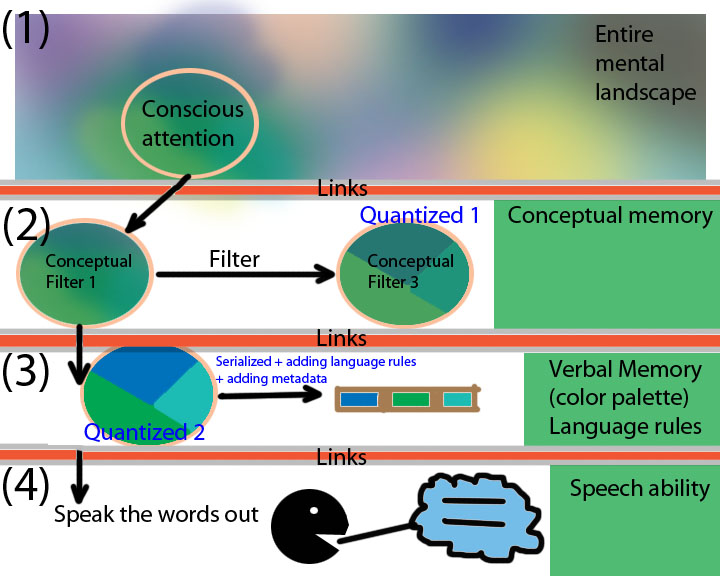
Model for Perception

The 1st block: Represents our entire mental activity in terms of its biochemical and electrical activity. It is a snapshot of the entire experience continuum of an individual. I have shown it symbolically using colors because there can be infinite combinations of various colors, saturation, contrast and opacity. This could be symbolically linked to everything we experience in a moment. Now not all of this is conscious, for example, if you do not think about your toe, you do not even know its there. There is this spotlight of conscious attention shown as the circle.

Then 2nd block: The conscious attention captures the spotlight of raw conscious experience. The raw experience keeps changing with time. The spotlight moves around in whatever regions it can quickly scan and stores a slice in immediate memory. Now, this raw input stored in the immediate memory is too complex and dynamic in its raw form. In order to create a stable graspable entity it is therefore simplified and quantized with the aid of the long term conceptual memory bank. Now, this new entity is more stable and can be grasped onto. How well you accomplish these steps depends on your awareness and attention.

In the 3rd block: Here we need to convert this raw feeling into words. The level of detail you put into this stage depends upon your vocabulary. Vocabulary in this analogy could be equated to a color palette. If your vocabulary is limited its like using a 1000 color palette. If it is extensive, it is maybe like using a 10000 color palette. Therefore another level of simplification happens here.The input that was grasped is approximated to its nearest colors and put into the language semantics framework. This stage also including serialization of the whole information. Its similar to trying to explain a picture in words. 

The 4th block: Finally how we speak the words out depends on our speech abilities i.e. have we learned to manipulate the vocal cord and tongue in sync.

Now, these blocks are connected by linkages which are bidirectional i.e. if you say the word dog in your mind, the corresponding conceptual feelings associated with the dog will show up and accordingly change your biochemistry. Also in the case of memory, its similar to wax. The memory impressions during a day also serve as filters during the extraction of meaning.

Prelude to a Model for Perception

Different people extract different slices of reality. Reality has infinite patterns within it. When we stay with the same slice for very long, the memory that other slices could exist become very distant and then we start longing for an adventure or some refreshing changes. A powerful and different experience revitalizes our whole mind almost like hitting reboot on our systems which clears the memory and cache.

As we grow older, our memory accumulates more and more and therefore the initial thrill and wonder is lost. Memory seems to be the enemy of wonder. After a point, it becomes very difficult to find brand new experiences which are yet to be encoded into memory. As an explorer myself, I often see first hand  the cycles of my passions i.e how they rise and diminish or keep shifting. I have intensely explored philosophy to study the basis of knowledge or experience itself. The interesting conclusion I have reached is that, life is mystery and it is this mystery that gives us meaning or anything that we can ever care about. The Japanese too have identified a concept called Yugen: Subtle yet profound mysteries. In fact these cycles indicate that learning is as important as unlearning OR remembering is as important as forgetting for they both symbiotically give definition to each other.

Our serial processing minds in language can process so little of what is going on since everything is dynamically changing. There is infinite breath and infinite depth. If you decide to direct your attention on a specific area, you would know its patterns from a certain depth, however a zillion other things have changed at the same time. If the move this concentrated attention to something else then again you former object would change without your awareness on it. This is the problem with our serial operation of the mind, as a result of which we can greatly distort reality.

The trickiest part is how can we understand all the relationships and patterns when everything is happening at once, with a serial processing mind in terms of language. It seems exactly like the blind man exploring an elephant. That too, you are tied to the extent of your vocabulary. Each word too can mean different things for different people. Even if you understand something profoundly and put it across in the best possible way, will you reader understand what you exactly meant?. Say I use the word “clear headed”. Now wont this mean totally different things to different people.

While talking to people, very little of what they mean is in their words. Their meaning needs to be holistically understood. I wonder if all the complicated talk that we do in our daily life, is like endlessly modifying the finger which is pointing to the moon, with the moon being what we actually want. In other words, we are endlessly playing with representations and symbols but not directly looking at what we really want. Its like a synthetic layer obscuring us from seeing the truth. We take terribly circuitous routes and get only a fraction of what we expected or we simply totally miss it. All our motivations could be examined in this light.

When we are thinking to ourselves, why do we words? Why can’t we think at a more symbolic level say with images or feelings. Maybe, we do this for social convenience. Is it because if we store everything verbally, then retrieval is much faster in societal environments since it is stored in a directly usable form? It seems obvious that higher forms of thought would be in the form of feelings and images since they can convey a lot more than a series of words arranged using grammar rules. Have you ever tried to write down what you experienced in a dream? Its extremely difficult because everything is rewired. While noting dreams down, I often need to use a lot of simplifications and often this greatly reduces the meaning of the dream for other people reading it. It could however serve as a cue to remind you of the experience itself in its raw form.

Another very intriguing aspect is how we literally talk to ourselves and tell ourselves what we should do or what decision to take. Why should we talk within ourselves like there is a separate entity inside us telling us in language what to do. Its almost like a big time trick played on us. People consider losing this verbal inner voice as a form of regression. I think its more like claiming back your original power which was totally lost by this trick which was played on us.

This whole thing is like a very interesting puzzle. Even I have this inner verbal voice inside me and for practical purposes, I treat that as me. But whenever I think about it, it seems absurd.Where is the real me? How can I remove this obscuration? Funnily and tragically, society generally firmly believes that “You only know something if you can put it in words”.

Problems with ritualized masturbation

Sexual fantasizing, masturbation and actual sex should not be simply something done to curb boredom. Ritualizing these acts all the more removes their sanctity. The fascination involved and the importance of these activities should not be relegated to a pastime. These acts should only be done when you really feel like doing them for their own sake, not as a pastime, ritual or for dealing with boredom. I’m speaking about this topic from a free thinkers perspective, this is not related to any religious ideas.

Now there are other tricky issues to deal with here. How do you know when you genuinely feel like doing them for their sake alone? Firstly, if you have ritualized it, you need to step out of that grind by diverting yourself from it as much as possible for a month maybe. This would drastically reduce the strength of the conditioning. Also, beliefs like “I must do it after so-so and so interval or else something is terribly wrong with me” need to be removed. There is no such thing to support that. For example: Even if we are not scared about falling asleep in the night, we still do. In fact, if this fear existed it would only hamper our sleep at best. Our biology works best when totally left to itself. Like our breathing, whenever we try to control it, it gets messed up and we again let go of it. So letting your body adjust its hormones as it wants is a perfectly normal thing.

The other thing is the psychological slavery. If thoughts of this nature, crowd your mind each time you feel bored or empty, then they would always drive you to seek these pleasures/activities. Its very difficult to divert that energy anywhere else. The point is not about NOT doing something. Its more about losing your mental freedom and being controlled by this mime(4-D object). Its works very similar to drugs like cocaine. We rush with the activity and take it to its closure, and we are at peace for a short while because of the prolactin rush. But the need again resurfaces after many hours or in the next day like nothing has ever happened.

After 10 years of it, I have realized that indulging more in these does not give more pleasure, in fact it creates a need, I end up having an abnormally high sex drive and the pleasure comes with diminishing returns. More than pleasure the satisfaction we derive from it is crucial. In this case, indulging in it makes me want more and more of it and the psychological satisfaction is diminished. It also reduces its significance if I am indulging a lot.

Its unbelievable to me too. After pursing these for over 10000 times, the craving still oscillates in the same way, like there is no time factor at all and nothing had ever happened. These highs are like whenever you reach the finish line you feel good but after a while the finish line itself moves forward and you have totally lost your accomplishment. This goes on endlessly. Its like a sine wave that keeps going on, when the wave is up, you are horny, when its down, its off season. If you willfully do it too many times, the cycle becomes erratic or increases its frequency giving the impression of a very high sex drive. If you divert yourself later, then the cycle once again reaches its homeostasis or natural rhythm.

The other problem is the stimulus needed. Especially in the case of photos and videos, the same ones do not work for very long. There is therefore a periodic search for newer, better or more intense ones and we reach a point of time when we almost get totally desensitized from everything. Nothing seems very exciting at all. At this point, the pleasure takes a dip and it starts yielding lower psychological satisfaction.

Another problem that this causes is in relationships. Masturbation is available to us all the time, its totally under our control. But in relationship, its gets more difficult. We may initially feel relived and joyous of not needing to rely on masturbation alone and transfer a good part of the need (preferably the entire need) onto the other person. Now, we would need to deal with another human being and their preferences. What if they have a lower drive or they have specific situations or preferences which you do not have? Then it gets quite frustrating. Though the pleasure derived from the same activities done with a partner are much more rewarding in pleasure, they are unpredictable. A lot of times, you may prep up yourself for an exciting time but would be disappointed if the partner’s interest seems low. This unpredictability/uncontrollability is the source for a lot of frustration and there would always be this strong drama, anger, and expectation. This makes truly loving someone very difficult. With all these differences, we may start to think purely of ourselves in a hedonistic way and just try to extract the most pleasure from this unpredictable situation.

Tolerance and Patience are difficult when we are used to huge doses of pleasure on a daily basis. If the other person is very like minded, then you may never encounter this issue. But given how unique we are, how likely is that? Even if you are a master of communication and pleasure (superbly capable of giving as well as receiving it), the other person may not have acquired the same level.
For some girls, they get attracted to such stuff only after having an experience of it first. Also factor in other behaviors from neurotic tendencies, conditioning, taboos, parental and societal influences, cultural influences, how much they have examined their own beliefs etc. In fact all these parameters impact all areas of life, not just in sex or romance.

Even great experiences create discomfort

Recently, I had a terrific out of the world experience. This stirred up my entire thoughts and in a way hijacked my brain. For the next few days, all I was doing was reliving moments of it and trying to remember every detail. No matter what I thought about, I would ponder over it again and again. Its like a stuck logical loop where I would think about ideas like: What was it really? What insights does it give me? What should I do to have an even better one? Should I pursue something similar? How will other people react if I tell them? How would I explain it to them? Would they be able to understand my translation of it?

What struck me is that, this is not the first time in my life this has happened. Interesting experiences hijack my entire attention and make me continually explore their mystery. The more intense it is, the more I’m pulled in.

I don’t know if I need to interpret this as discomfort in the first place. Its what I have been doing most of my life. I would be terribly fascinated with some object, game or person and keep intensely exploring that until the interest naturally fades into something else. I have seen a lot of people around me however, do not live life with that intensity. Even if they do, the intensity is only for certain things and not versatile or really broad. It also stays more or less constant. For e.g.: among the people I know, there is an obsession with knowing the latest gossip or information, maintaining a oneupmanship, tapping into the easiest sources of money, increasing one’s value in the market etc.

About Dopamine:
Once dopamine is involved in the picture, it hugely dominates. The real obsessive experience starts when an entity stimulates dopamine. That makes the obsession much much stronger. I guess our whole motivation and behavior is biologically adjusted to all the activities that maximize dopamine. So they would theoretically be the most powerful forces. In fact dopamine is the key force of attraction.

Why the reward system may be fair after all
For a long time I felt, pretty girls have an inherent advantage since more people want to get to know them and their opportunity for interacting with others is maximized. However, if they get attention easily, they may not bother to develop other skills and attitudes needed for pleasure not related to looks. Average looking people usually develop in other areas and by virtue of facing rejections etc. develop greater empathy, stronger personalities and develop other talents and interests which help them gain rewards. The more I think about it, I feel no one has any real advantage. You can rewards in spikes or get it slowly but the wave will still be maintained with its crests and troughs.

Giving a starving man a loaf of bread gives him as much pleasure as a middle class man gets eating in a 5-star restaurant. In the pretty girl example: If some guy gives her a lot of attention, she would not be too bothered by it because she gets it in abundance. But if this level of attention is received by an average girl, she would be really moved and rewarded much more.

So, do some people really subjectively experience more pleasure than others?
We can never compare 2 subjective experiences, even my comparison would be my subjectivity. So the answer to this question is almost unknowable.
2 things strike my mind when I think about this.
1. Analyzing the biology of the person’s brain, nervous system etc for the main neurotransmitters and chemicals influencing subjective experience.
2. Understanding the person’s beliefs and how they are functioning: empowering/dis-empowering him

But even these factors may not indicate subjective experience. There is an inherent duality here.
Say there are Person A: with less dopamine and Person B with more dopamine. Person B may have more dopamine in his system, but he has always had it, he would know the value of it only if he can experience person A. Similarly person A would have no idea what having the level of dopamine person B has feels like. Person A cannot even imagine it.

So the conundrum is that wherever we are in life, we always feel we are in the center. The frame of reference itself moves along with us. We are always craving for better things, avoiding the bad stuff. We try to map our place by comparing ourselves to others and that gives us orientation. But this is a comparison in an artificial reality. There is no compass, no map, no circumference, no location in actual reality.